While You Were Panic-Selling, Ripple Was Buying the Pipes

Price fear, capitulation data, and $3 billion in acquisitions — two clocks are ticking on the same asset.
Two clocks are running on XRP right now.
One belongs to the market. The $1.40 support broke, price slid to the low $1.30s, and 24-hour trading volume spiked nearly 50%. Fear is spreading that if $1.30 gives way, things could get worse.
The other belongs to Ripple. Since 2023, the company has spent roughly $3 billion acquiring custody providers, prime brokers, stablecoin payment platforms, and corporate treasury software. CEO Brad Garlinghouse is putting the odds of the Clarity Act becoming law by April at 80%. While the market panics over a price level, the company is assembling institutional infrastructure.
Both clocks point to the same asset. They measure different things. This piece doesn't argue which one is right. It separates what each is tracking and asks: when — if ever — do they converge?
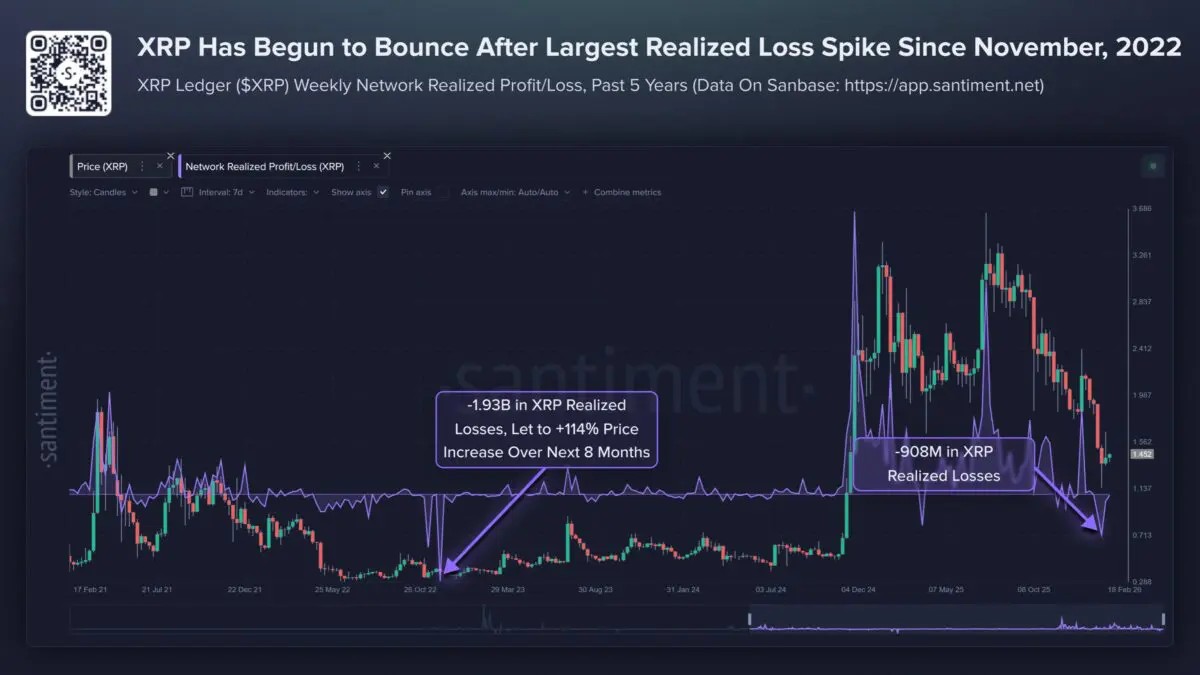
The Capitulation Footprint: What $2 Billion in Realized Losses Actually Tells Us
Santiment data shows roughly $2 billion in on-chain realized losses on the XRP network over the past week — the largest since November 2022, when the figure hit approximately $1.93 billion.
Realized loss means investors actually sold at a price below what they paid. It's not paper losses sitting in a wallet. It's confirmed exits at confirmed losses. When this number spikes, it means people have stopped holding and started capitulating.
In market structure terms, this is a neutral signal with two competing readings.
The bullish case: When weak hands — investors who sell under psychological pressure — exit in size, the pool of potential future sellers shrinks. Fewer sellers remaining means less overhead supply, and theoretically, less buying power is needed to push price higher. The historical precedent is notable: after a similar-scale capitulation in November 2022, XRP rallied 114% over the following eight months.
The cautious case: The same reporting notes that market conditions in 2026 differ meaningfully from 2022, and this could turn out to be a technical bounce rather than a structural bottom.
The honest position is straightforward. This data is not a bottom call. It is a capitulation footprint. For it to become a meaningful signal, three things need to follow: the pace of additional realized losses should slow, volume spikes should transition into price stabilization, and subsequent dips should find higher lows. Until those conditions are met, we are observing a process, not declaring an outcome.
"Something Big Is Brewing" — Turning a Teaser into a Checklist
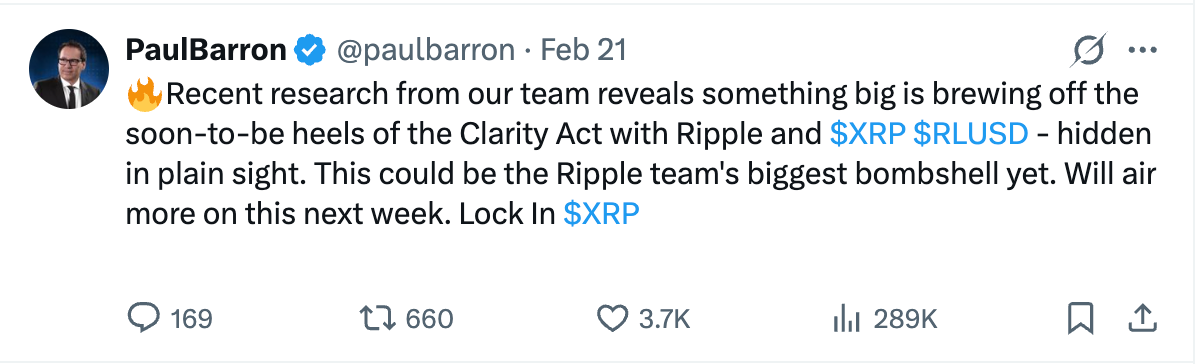
The most viral sentence in the XRP community this week came from media personality Paul Barron, who posted on X that his research team had uncovered "something big" tied to the Clarity Act — something "hidden in plain sight" — with more details promised next week. TheCryptoBasic covered the post.
This kind of teaser performs one function in markets: it raises expectations. And expectations are not information.
The productive response is neither to believe nor to dismiss. It's to ask: if this is real, what form would confirmation take?
First, the Clarity Act's legislative progress. Garlinghouse has cited an 80% probability of the bill becoming law by April, and reporting indicates it is heading toward Senate Banking Committee markup. The metric that matters isn't a probability quote from a CEO — it's whether the procedure actually advances to the next stage: committee vote, floor debate, passage.
Second, RLUSD and institutional partnerships moving from abstract to official. "Banks could adopt this" is a sentence that appears in crypto news weekly. The inflection point comes when a specific institution, in a specific format, makes a specific commitment.
Third, XRPL usage data accumulating in numbers, not narratives. Transaction counts, liquidity depth, and institutional participation rates need to show up in charts, not just in hopeful commentary. The same TheCryptoBasic article acknowledges that token burn effects on price may be minimal. Usage data matters more than burn mythology.
"Brewing" is not a catalyst. It's a calendar. The conditions above either get met or they don't.
What Ripple Bought with $3 Billion: Not Tokens — Pipes
Now for the other clock.
TheCryptoBasic reported on Garlinghouse explaining why Ripple has spent $3 billion on acquisitions since 2023. The number itself is less important than the direction of the spending.
For institutions to use digital assets in practice, a fast blockchain isn't enough. They need compliant custody, regulatory licenses, clearing and collateral infrastructure, and treasury management software that a CFO can actually use. Ripple's acquisition list reads like a checklist filling each of those requirements.
First, the trust layer — what institutions need before they touch anything. In 2023, Ripple acquired Swiss custody firm Metaco for $250 million. In 2024, it added Standard Custody, a New York Department of Financial Services-regulated trust company. These weren't growth bets on token price. They were answers to the first questions any institutional compliance officer asks: who holds the assets, and under what regulatory framework?
Then, the operational layer — the pipes through which money actually flows. The pace accelerated in 2025. Ripple acquired Hidden Road, a multi-asset prime broker clearing roughly $3 trillion annually for over 300 institutional clients, for $1.25 billion. Reuters noted that Ripple's RLUSD stablecoin is being used as collateral across Hidden Road's products. It then added Rail, a stablecoin payments platform, for $200 million, and GTreasury, a corporate treasury management software provider serving over 1,000 enterprise clients, for $1 billion.
Taken individually, these are separate deals. Connected, they form a single picture: Ripple is not buying token price exposure. It is assembling the full plumbing that institutions need to move money through digital asset rails.
The Honest Counterargument: Do the Pipes Actually Need XRP?
There's a question that can't be skipped if this analysis is to be fair. Does Ripple's success automatically translate to XRP demand?
Not necessarily. Two structural counterarguments exist.
The first is the bridge asset limitation. Even if institutions use XRP for cross-border settlement, the typical flow involves buying and selling XRP within seconds. Volume increases, but holding demand doesn't. If XRP is only ever held for the duration of a transaction, sustained price pressure may not materialize regardless of how much volume flows through the network.
The second is RLUSD substitution. Ripple's payment network can operate without XRP in some corridors, and stablecoins offer the same settlement function without volatility. If RLUSD captures roles the market expected XRP to dominate, ecosystem growth and token price could diverge.
So the metrics to watch aren't about holding — they're about breadth of use. Specifically: whether transaction volume on XRPL is growing, whether network fee revenue is rising alongside usage, and whether XRP and RLUSD are expanding their role as collateral in institutional infrastructure like Hidden Road. If all three stack up simultaneously, that's evidence the pipes are generating XRP demand. If only one moves while the others stall, the counterargument gains weight.
Two Clocks, One Observation Framework
Here's where we land.
The market's clock is recording fear and capitulation at $1.30. Two billion dollars in realized losses confirm that people have exited — and history suggests, but does not guarantee, that such exits have preceded strong recoveries.
Ripple's clock points somewhere else entirely. Three billion dollars in acquisitions have assembled institutional plumbing from custody to prime brokerage to corporate treasury, and a regulatory calendar — the Clarity Act — is ticking toward April.
The two clocks may align. They may diverge further. Either way, the thing that narrows the gap between them isn't someone's tweet or teaser. It's three observable facts.
Is selling pressure actually declining after capitulation? Is Ripple's M&A moving from announcements to usage? Is the Clarity Act advancing from sentiment to procedure?
Until those questions are answered by data, what the market asks of us isn't prediction. It's observation.
This article is based on publicly available media reports, on-chain analytics, and corporate disclosures. It does not constitute investment advice. All investment decisions and their outcomes are the sole responsibility of the reader.
[1]: https://thecryptobasic.com/2026/02/21/research-team-reveals-something-big-is-brewing-for-xrp/ "Research Team Reveals Something Big Is Brewing for XRP"
[2]: https://thecryptobasic.com/2026/02/23/ripple-ceo-reveals-primary-reason-ripple-has-spent-3b-in-acquisitions-since-2023/ "Ripple CEO Reveals Primary Reason Ripple Has Spent $3B"
[3]: https://www.reuters.com/markets/deals/ripple-buys-crypto-custody-firm-metaco-250-million-2023-05-18/ "Ripple buys crypto custody firm Metaco for $250 million"
[4]: https://www.businesswire.com/news/home/20240213022752/en/Ripple-Announces-Acquisition-of-Standard-Custody-Trust-Company "Ripple Announces Acquisition of Standard Custody & Trust"
[5]: https://www.reuters.com/markets/deals/crypto-firm-ripple-buy-prime-broker-hidden-road-125-billion-2025-04-08/ "Ripple to buy prime broker Hidden Road for $1.25 billion"
[6]: https://www.reuters.com/legal/transactional/ripple-buy-stablecoin-platform-rail-200-million-2025-08-07/ "Ripple to buy stablecoin platform Rail for $200 million"
[7]: https://www.gtreasury.com/news/ripple-acquires-gtreasury "Ripple Breaks into Corporate Treasury with $1B GTreasury Acquisition"
[8]: https://www.financemagnates.com/cryptocurrency/ripple-makes-1b-bet-on-corporate-treasury-payments-with-gtreasury-acquisition-deal/ "Ripple Makes $1B Bet on Corporate Treasury Payments"