Has the Fear Around Ripple Outrun the Law? What the CLARITY Act Actually Says About XRP
The market read "20% means forced selling." The CLARITY Act actually asks whether control exists. With XRP now officially classified as a digital commodity, Ripple's legal discount rate may be ripe for reassessment.

The market read "20% means forced selling." The statute asks "does control exist?" — The real question for Ripple isn't whether it moons, but whether its legal discount rate is about to shrink.
Ripple has always been an asset where fandom and skepticism collide at extremes. But market price is a function of discount rates far more than it is a function of sentiment. And the single largest factor that has kept Ripple's discount rate elevated for years is not a technology debate — it is legal uncertainty. The most recent wave of fear centered on the CLARITY Act and what the community dubbed the "20% rule": the idea that because Ripple holds so much XRP, it will eventually be forced by law to sell off a massive portion of its supply. That fear gains traction because the name Ripple is already hardwired to regulatory risk in most investors' minds. But the fact that a fear resonates does not mean its underlying interpretation is accurate. What is needed at this point is not more interpretation. It is the actual text.
DATA BOX: 5 Key Facts Behind This Analysis
① Ripple currently holds approximately 33.5 billion XRP in escrow and roughly 5 billion in spendable wallets, totaling about 38.5 billion XRP — approximately 40% of total supply. ② The CLARITY Act (H.R. 3633) uses control, voting power, and decentralization — not raw token holdings — as the core criteria for evaluating "mature blockchain systems" and "blockchain control persons." ③ The "20%" figure in the statute refers to voting power in vote-capable blockchain systems, not to token supply ownership. ④ On March 17, 2026, the SEC and CFTC jointly classified XRP as a digital commodity alongside Bitcoin, Ethereum, and Solana. ⑤ The CLARITY Act passed the U.S. House in July 2025 but remains under reconciliation with a separate Senate bill (RFIA). The final form is not yet determined.
1. What Was the Market Afraid Of? The Anatomy of the "Forced Selling" Narrative
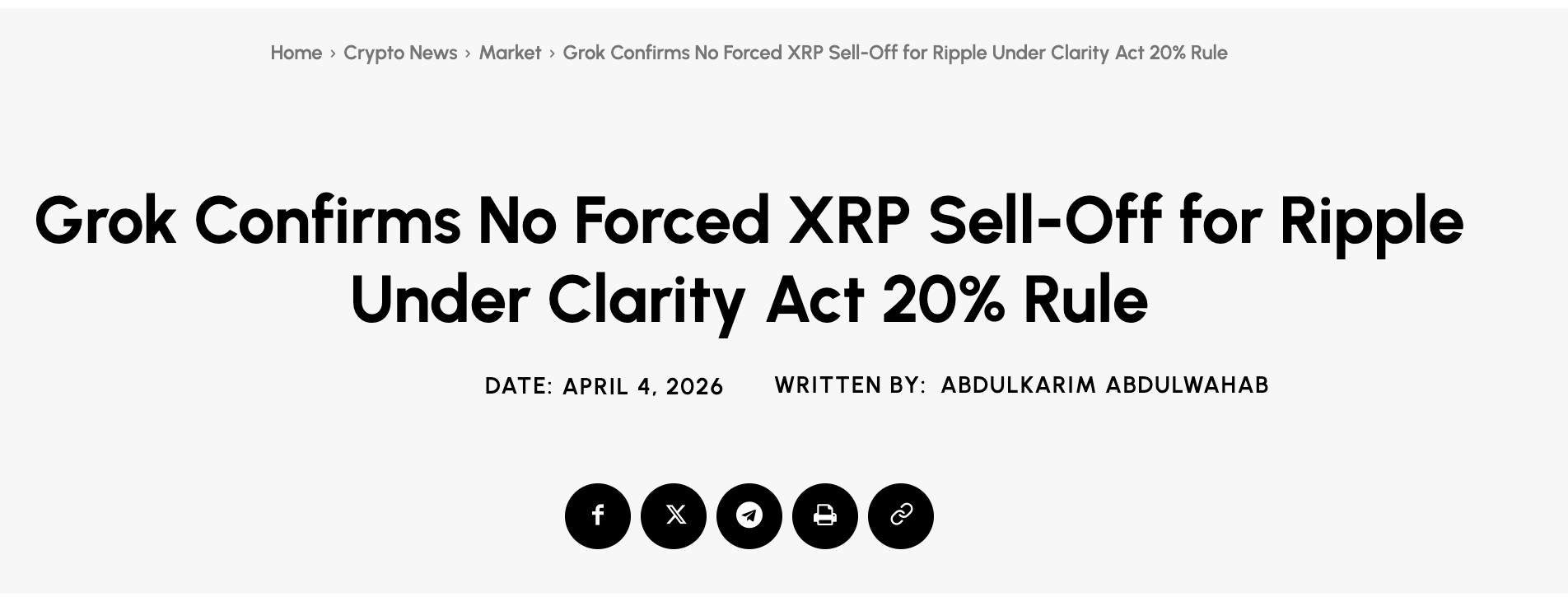
The core of the recent fear around Ripple can be summarized in one sentence: the CLARITY Act contains something like a 20% ownership cap, Ripple holds roughly 40% of all XRP, and therefore the law will force Ripple to dump half its holdings. As TheCryptoBasic reported, some community estimates went as far as suggesting Ripple might need to sell or burn over 17 billion XRP from escrow to comply.
The background to this fear is understandable. Ripple endured nearly six years of SEC litigation. Investors have been conditioned to expect regulatory risk at every turn. The problem is that the logical structure of this fear sits at a considerable distance from the actual statutory text. The wider the gap between community interpretation and legal document, the more the market overcharges in discount rate. And that excess discount rate may be explaining part of XRP's current price.
2. Reading the Statute — The Issue Is Control, Not Holdings
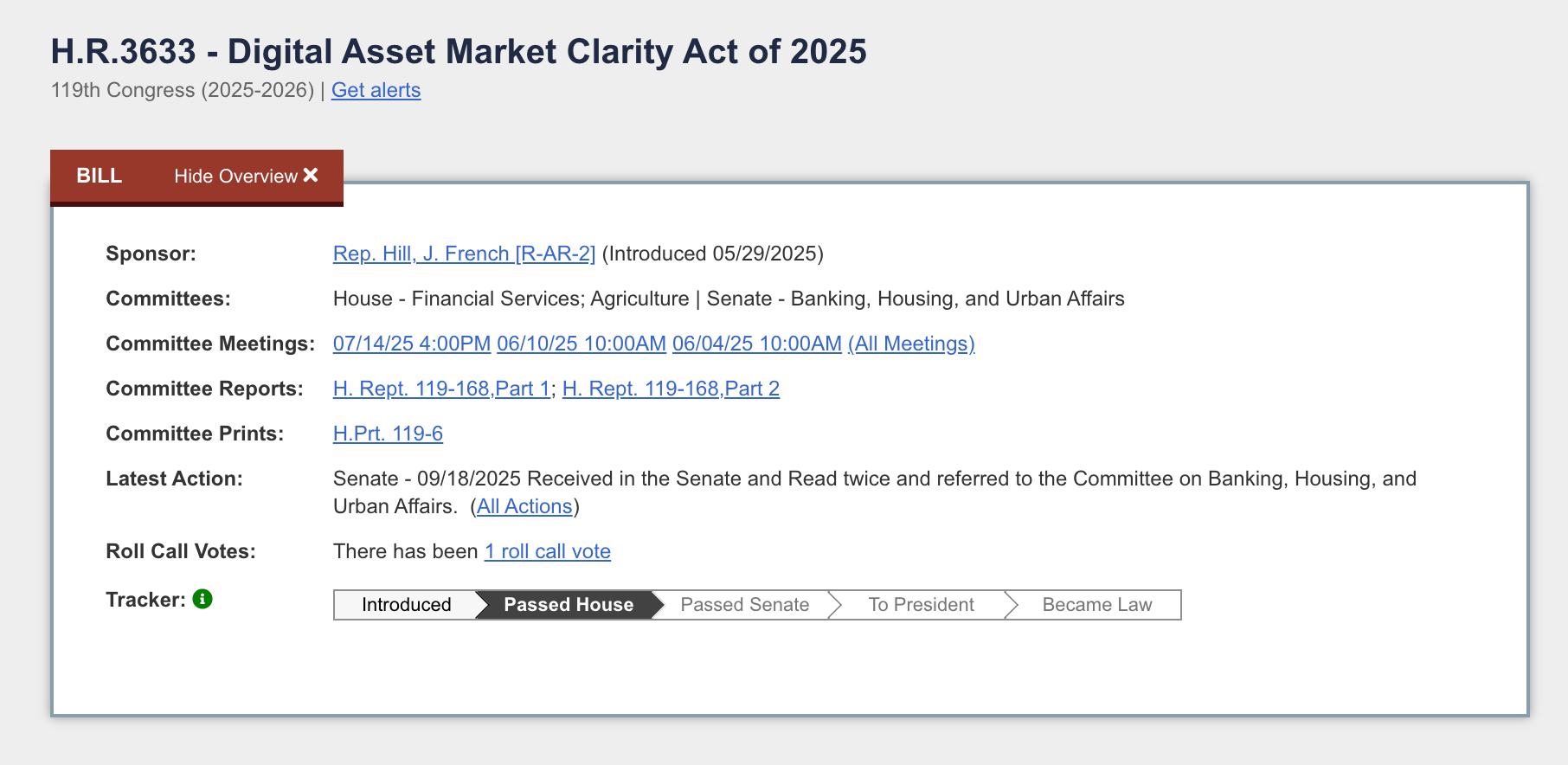
The full text of the CLARITY Act (H.R. 3633) does not approach digital assets with a "ban or force divestment" structure. The bill classifies digital assets into three categories — digital commodities, investment contract assets, and permitted payment stablecoins — and builds a transition mechanism through which a network can be certified as a mature blockchain system under defined conditions.
The criteria for maturity do not center on raw token holdings. The statute requires demonstration that the system is not controlled by any individual or group of persons under common control. The fundamental question is not "how much does someone hold?" but rather "does that holding translate into actual control over the network?"
DATA BOX: The Three Digital Asset Categories Under CLARITY Act
| Category | Regulatory Jurisdiction | Core Criteria |
|---|---|---|
| Digital Commodity | CFTC | Intrinsically linked to blockchain functionality; sufficient decentralization |
| Investment Contract Asset | SEC | Digital commodity sold via investment contract; returns dependent on centralized entity |
| Permitted Payment Stablecoin | SEC + CFTC + banking regulators | Fiat-pegged; separate framework under GENIUS Act |
Sources: CLARITY Act Section-by-Section (House Financial Services Committee), Arnold & Porter Advisory
3. The Truth About "20%" — It's a Voting Power Threshold, Not a Supply Ownership Cap
This is the most widely oversimplified element of the entire debate. Reading the "blockchain control person" provision directly from the statute, the test for whether someone qualifies as a control person runs along two tracks.
The first track asks whether a person or group under common control has the authority — through any contract, arrangement, understanding, or relationship — to unilaterally control or materially alter the functionality, operation, or rules of consensus of the blockchain system. This is about governance power over the network itself, regardless of how many tokens someone holds.
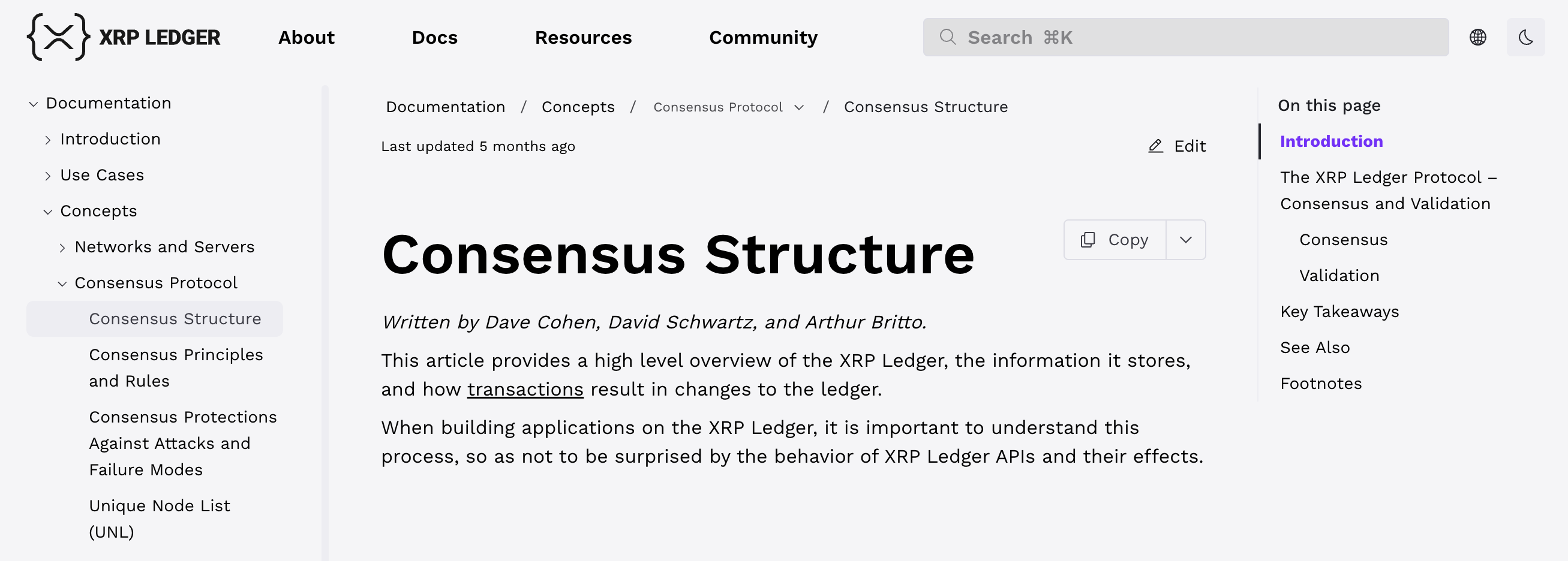
The second track asks whether, in a blockchain system that can be modified through a voting mechanism, a person can unilaterally direct 20% or more of the total voting power. This is where the "20%" number appears. But it is 20% of voting power, not 20% of token supply. Token holdings and voting power are distinct concepts. This distinction is especially significant for XRP Ledger, which does not operate on a vote-based governance structure. XRPL's consensus mechanism relies on a Unique Node List (UNL) rather than Proof-of-Work or Proof-of-Stake. Whether the "20% rule" applies to XRP at all is itself a separate legal determination.
4. The Statute Does Not Say "Don't Sell" — It Says "If You Sell, Sell Transparently"
The effect of these provisions also diverges from the market's simplified version. Examining Section 411 (Requirements related to control persons) of the CLARITY Act, the bill does not impose an automatic forced divestiture. Instead, it requires that when a blockchain control person sells digital commodities associated with a mature system, that sale must go through registered intermediaries, be accompanied by disclosure obligations, and comply with additional restrictions designed to prevent market distortion and manipulation.
The direction is market integrity, not compulsory liquidation. The statute is closer to "if you sell, do it transparently and without shocking the market" than it is to "you must sell." This difference matters enormously for Ripple investors, because markets routinely translate legal language into fear narratives, and that fear gets priced in before anyone reads the actual text.
DATA BOX: "Forced Selling" Frame vs. Statutory Text — Key Comparison
| Dimension | Market Interpretation | CLARITY Act Text |
|---|---|---|
| Threshold | 20% of token supply | 20% of voting power + substantive control |
| Effect | Automatic forced sale or burn | Disclosure, intermediary, and sale restriction obligations |
| Scope | All large holders | Only those meeting blockchain control person criteria |
| XRPL applicability | Assumed to apply directly | Requires separate legal analysis (non-vote-based governance) |
5. What Has Already Moved — The Practical Significance of SEC-CFTC Commodity Classification
The transition mechanism embedded in the CLARITY Act is not purely theoretical. On March 17, 2026, the SEC and CFTC issued joint interpretive guidance officially classifying 16 digital assets — including Bitcoin, Ethereum, Solana, and XRP — as digital commodities.
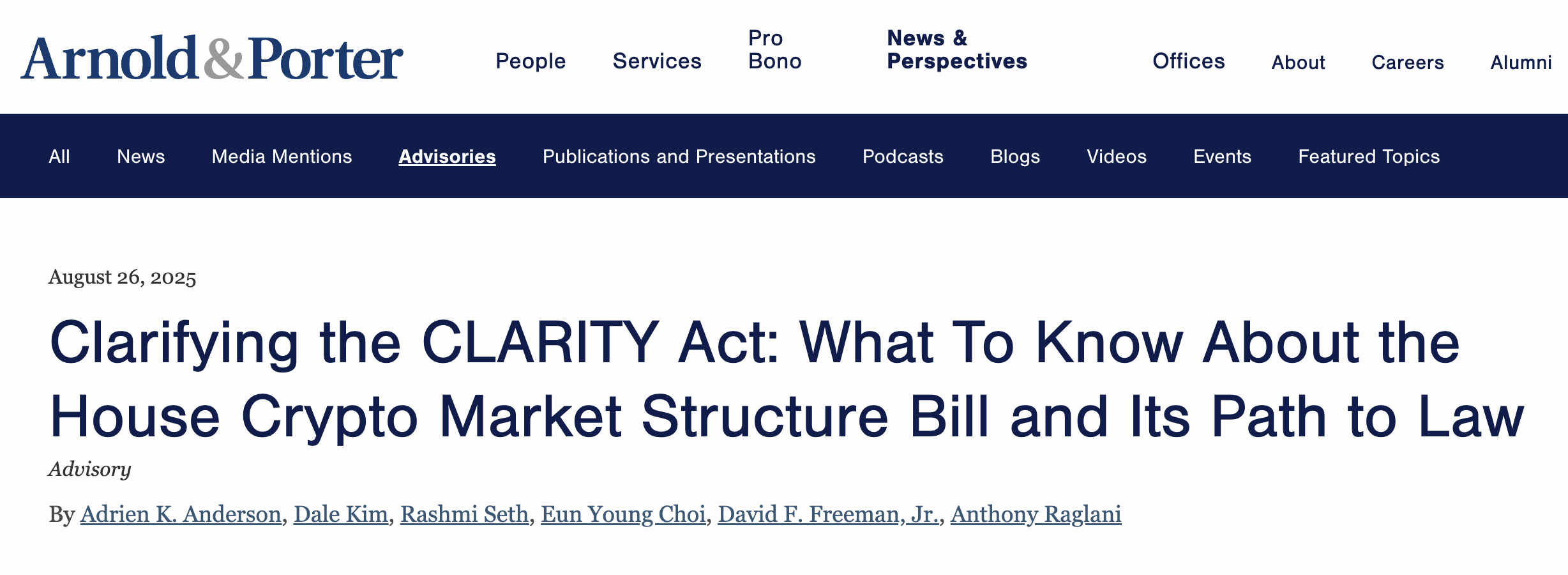
The significance of this classification extends beyond labeling. As Arnold & Porter's legal analysis explains, under the CLARITY Act's framework, assets classified as digital commodities move from SEC securities jurisdiction to CFTC oversight, benefiting from lighter compliance requirements and clearer secondary market trading rules. The legal determination that XRP is not a security — which had previously been confined to a 2023 court ruling — has now expanded into the official regulatory framework of both agencies.
This matters because it directly affects the discount rate structure. A significant portion of the risk premium investors assigned to XRP was based on the lingering anxiety that XRP might be reclassified as a security. As commodity classification becomes formalized, the foundation for that anxiety narrows, and as it narrows, the discount rate has room to adjust downward.
6. The Core Question for Ripple Is Not "Will It Moon?" — It's "Can the Legal Discount Rate Shrink?"
A more productive way to evaluate Ripple is to abandon the binary of "forced selling is real vs. it isn't." The more important question is this: can the legal discount rate that the market has assigned to Ripple actually decrease going forward?
As Arnold & Porter's analysis frames it, the CLARITY Act represents an attempt to institutionalize a classification and transition mechanism for digital assets. When viewed through this lens alongside the SEC-CFTC commodity classification, the legal discount rate that has accumulated around XRP through years of litigation may be overstated relative to the actual remaining risk.
That said, this is not an all-clear signal. The CLARITY Act passed the House but is still being reconciled with a separate Senate bill (RFIA). The final legislative form remains undetermined. The commodity classification itself is interpretive guidance, not a permanent statutory shield against every conceivable regulatory scenario. What matters is direction over speed, and conditions over conclusions.
7. What to Watch — A Ripple Conditions Checklist
What actually helps investment judgment on Ripple is not the emotional swing between fear and hope. It is tracking whether the conditions for discount rate compression are activating.
Condition ① — Does the CLARITY Act achieve real legislative progress? The House vote is done. The Senate process remains. The Senate Banking Committee is advancing the RFIA, a parallel bill with different emphases. How these two are reconciled will shape the final regulatory framework. What matters is not community interpretation but whether the institutional process is actually advancing.
Condition ② — Does the digital commodity classification gain acceptance across other regulatory frameworks? The SEC-CFTC joint guidance is a milestone, but it does not close every scenario. Whether the same classification logic extends to banking regulation, state-level law, and international regulatory bodies is equally important. A single interpretive statement is insufficient. The alignment of language across the entire institutional landscape is what counts.
Condition ③ — Does Ripple voluntarily signal structural adjustments to its escrow and holdings? Not because the law forces it, but because the market rewards it. Changes to escrow release schedules, enhanced transparency, or third-party audits of the holding structure would be the most direct catalysts for discount rate compression. If these signals emerge voluntarily, they carry more weight than any regulatory mandate.
These three conditions are not "moonshot triggers." They are discount rate compression triggers. Framing them this way makes it possible to follow structure rather than oscillate between fear and euphoria.
FACT / INTERPRETATION / IMPLICATION
FACT: The CLARITY Act is a market structure bill designed to institutionalize classification and transition mechanisms for digital assets. Its criteria for mature blockchain systems and blockchain control persons center on control, voting power, and decentralization — not raw token holdings. The SEC and CFTC jointly classified XRP as a digital commodity on March 17, 2026. Ripple holds approximately 38.5 billion XRP, roughly 40% of total supply.
INTERPRETATION: The simplified "20% means forced selling" frame circulating in the market does not align with the statutory text. The statute examines control structures, not supply percentages, and its effect is regulatory discipline on sales practices, not automatic divestiture. The legal discount rate the market has priced into XRP may be overstated relative to the actual risk embedded in the legislation.
IMPLICATION: Evaluating Ripple going forward requires monitoring three conditions: (1) whether the CLARITY Act achieves real progress in the Senate, (2) whether digital commodity classification gains wider regulatory adoption, and (3) whether Ripple voluntarily signals structural adjustments to reduce market discount. If these conditions activate, discount rate compression can begin to reflect in price. If none move, the current fear premium may persist longer than expected.
Conclusion: Verifying the Logic Behind the Fear Is Where Investment Judgment Begins
The fear around Ripple is not baseless. A roughly 40% holding concentration is a legitimate question for any asset, and the regulatory landscape is not fully settled. But if that fear has been constructed on a reading of the law that is rougher and more exaggerated than the actual text, then part of the discount rate is built on misunderstanding rather than substance. Price is always a composite of expectation and discount rate. When legal misreading inflates the discount rate beyond what the actual risk warrants, correction of that misreading creates room for repricing. That is why the core question for Ripple is not "will it go up?" but rather "what is the market discounting, and is that discount accurate?" Hold that question, and it becomes possible to stay grounded through both fear and hype. Read the conditions. Reserve conviction.
Source Table
Primary Sources
| No. | Source | URL |
|---|---|---|
| 1 | CLARITY Act Full Text (H.R. 3633) — Congress.gov | https://www.congress.gov/bill/119th-congress/house-bill/3633/text |
| 2 | CLARITY Act Section-by-Section — House Financial Services Committee | https://financialservices.house.gov/uploadedfiles/2025-07-10_-sbs-_clarity_act_of_2025_final.pdf |
| 3 | Arnold & Porter — Clarifying the CLARITY Act Advisory | https://www.arnoldporter.com/en/perspectives/advisories/2025/08/clarifying-the-clarity-act |
| 4 | TheCryptoBasic — SEC Officially Classifies XRP as Digital Commodity | https://thecryptobasic.com/2026/03/18/sec-officially-classifies-xrp-as-a-digital-commodity/ |
Secondary Sources
| No. | Source | URL |
|---|---|---|
| 5 | TheCryptoBasic — Grok confirms no forced XRP sell-off under CLARITY Act 20% rule | https://thecryptobasic.com/2026/04/04/grok-confirms-no-forced-xrp-sell-off-for-ripple-under-clarity-act-20-rule/ |
| 6 | TheCryptoBasic — Will Ripple sell or burn 17B XRP as CLARITY Act imposes 20% limit? | https://thecryptobasic.com/2025/12/10/will-ripple-sell-or-burn-17b-xrp-in-escrow-as-clarity-act-imposes-a-20-holding-limit/ |
| 7 | FinTech Weekly — What Is the CLARITY Act? | https://www.fintechweekly.com/news/what-is-the-clarity-act-digital-asset-market-structure-explained-2026 |
Contextual Sources
| No. | Source | URL |
|---|---|---|
| 8 | TheCryptoBasic — Why would global banks use XRP if Ripple holds 38B tokens? | https://thecryptobasic.com/2026/04/02/why-would-global-banks-use-xrp-and-drive-up-its-price-if-ripple-holds-38b-tokens/ |
| 9 | Morgan Lewis — Bipartisan Majorities Advance the CLARITY Act | https://www.morganlewis.com/pubs/2025/06/bipartisan-majorities-in-two-house-committees-vote-to-advance-the-digital-asset-market-clarity-act-of-2025 |
| 10 | DLA Piper — CLARITY Act: The increasing role of the CFTC | https://www.dlapiper.com/en/insights/publications/2025/06/digital-asset-market-clarity-act |
| 11 | Senate Banking Committee — The Facts: The CLARITY Act | https://www.banking.senate.gov/newsroom/majority/the-facts-the-clarity-act |
This post does not constitute a recommendation to buy or sell any asset. All investment decisions and their consequences are the sole responsibility of the investor. Cryptocurrencies carry high volatility and the risk of principal loss. The analysis and opinions contained herein are based on publicly available information at the time of writing and may change as circumstances evolve. Always consult a qualified professional before making investment decisions.
![[마켓 분석] 비트코인 8만 달러 앞에서 멈춘 시장](https://storage.ghost.io/c/8c/af/8caf2296-06bf-4501-ae99-5e72cb676b76/content/images/size/w600/2026/04/63d9df35-5d28-48fe-9a7a-3f651c82aafe.png)