How Far Has Wall Street's Crypto Return Actually Gone? — Schwab's Door, Fidelity's Thesis, Grayscale's Alt Selection, and XRP's Quiet Supply Signal
The market hasn't made up its mind, but Wall Street is already turning back toward crypto. Schwab opens the door, Fidelity provides the thesis, Grayscale reveals the selection order — and XRP quietly shows supply-side movement that doesn't fit the main narrative.

TL;DR
When you line up four recent developments into a single sequence, the picture shifts. This isn't a market where everything pumps at once. It's a market where institutional plumbing is being laid — Bitcoin is being re-read as a portfolio asset, a handful of large-cap alts are being selected for the next phase, and a quieter asset like XRP is showing subtle supply-side movement that doesn't fit neatly into the main narrative.
1. Why Schwab's Entry Matters — It's Not a Catalyst, It's a Channel
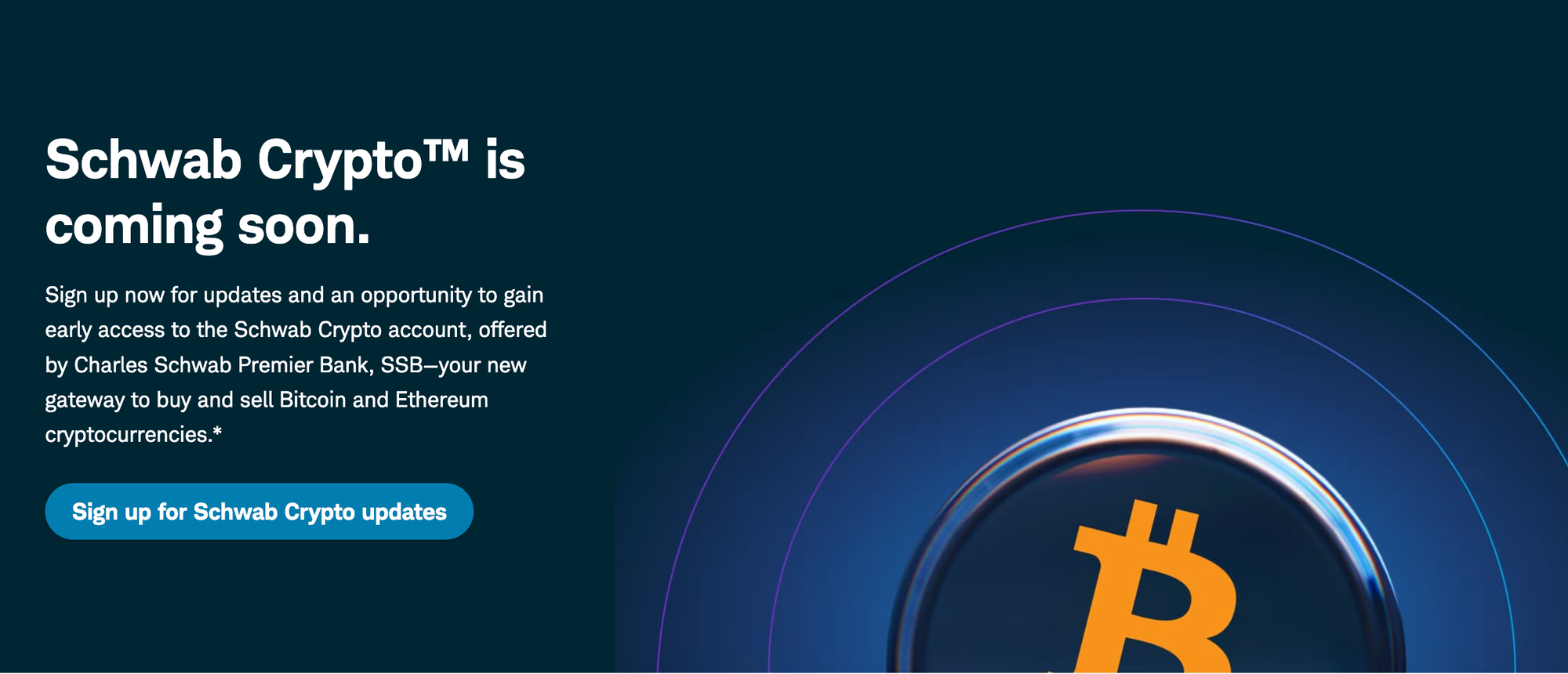
The first scene to watch here isn't price — it's access. Schwab Crypto is still in "coming soon" mode, but the significance lies less in the launch date and more in who is opening the door. Schwab has announced a direct trading account for BTC and ETH, and this is a firm managing over $12 trillion in client assets with 38.7 million active brokerage accounts. According to Decrypt, Schwab confirmed it plans to launch spot crypto trading in the first half of 2026, with a waitlist already open. The service will be available across all U.S. states except New York and Louisiana.
This isn't just "another app where you can buy Bitcoin." It means crypto is moving deeper into the financial infrastructure that tens of millions of American investors already use every day.
The smarter read here isn't "Schwab is bullish, therefore up." It's colder than that. Schwab isn't listing every altcoin under the sun — it's starting with BTC and ETH only. That tells you something about how institutional gatekeepers think. The first door opens for the largest, most explainable, most regulation-friendly assets. This isn't a signal that the entire market is about to lift off. It's a signal that crypto's internal hierarchy is being re-confirmed by the very institutions entering the space.
What deserves more emphasis is that this channel expansion isn't an isolated event. ETFs established the first layer of institutional exposure in 2024. Now brokerage-level direct access is being added on top. When crypto moves from being a "specialty asset" to occupying a line item on the same platform where people hold stocks and bonds, that's a structural shift — not a price catalyst, but something more durable.
DATA BOX — Schwab Key Figures Client Assets (AUM): $12T+ (as of Jan 2026) | Active Brokerage Accounts: 38.7M | Supported Assets: BTC, ETH (direct trading) | Coverage: All U.S. states except NY and LA | Status: Coming Soon (H1 2026 launch)
2. Fidelity's More Important Signal — Why Bitcoin, Why Now
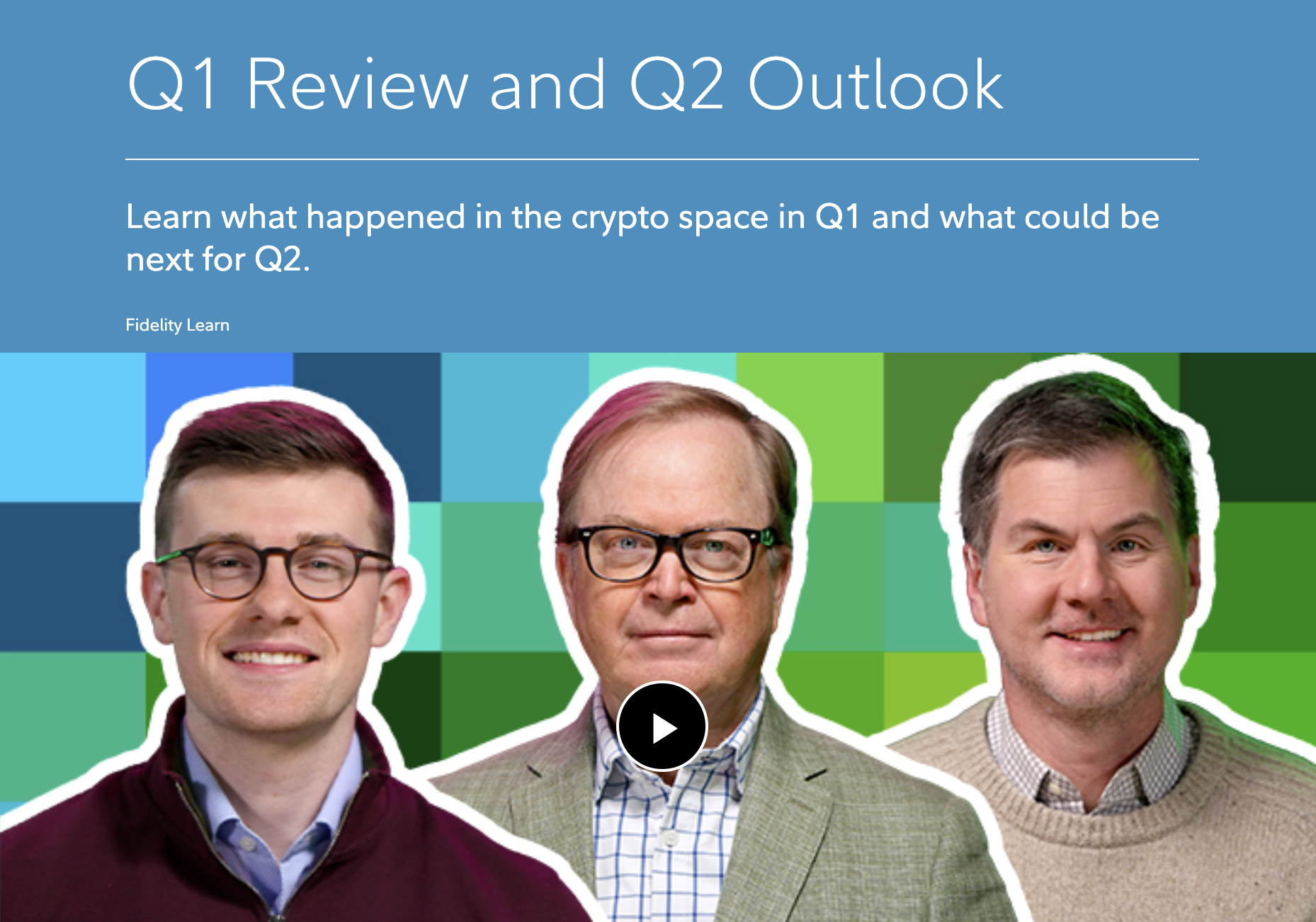
If Schwab is the what, Fidelity is the why. In Fidelity's Q1 2026 Review and Q2 Outlook, Jurrien Timmer — the firm's director of global macro — frames Bitcoin not as a pure speculation vehicle, but as an asset with a dual identity. One face is "hard money," sitting alongside gold and silver as an alternative store of value. The other face is a speculative risk asset that tracks tech sentiment.
This matters because it prevents the lazy binary — "Bitcoin is a safe haven" vs. "Bitcoin is a risk asset." In Timmer's framework, Bitcoin shifts between these roles depending on the macro environment and investor psychology. And right now, he sees the hard-money face starting to reassert itself.
The evidence he points to is the gold-to-Bitcoin ratio. Gold has dramatically outpaced Bitcoin over the past couple of years, and Timmer's recent analysis suggests that the flow reversal has already begun — investors who piled into gold in late 2025 are starting to rotate back toward Bitcoin. Gold's momentum is fading, while Bitcoin is finding its footing at current support levels.
Translated into portfolio language: last year, nervous capital fled to gold. Now, some of that capital is reconsidering Bitcoin as a hard-money alternative. This isn't a "Bitcoin to the moon" call. It's a re-emergence of the portfolio allocation thesis — the idea that Bitcoin deserves a seat at the table not because of hype, but because of its role as a diversifier outside stocks and bonds. Timmer himself describes the current zone as one worth examining from a valuation and price-discovery standpoint for long-term investors.
The deeper point — one that's easy to overlook — is that this isn't just Fidelity being bullish. It's Bitcoin being translated back into the language of asset allocation. When institutional money moves, it doesn't move because "the tech is cool." It moves because someone can explain what portfolio role the asset plays. Fidelity is doing exactly that translation work right now.
DATA BOX — Fidelity's Core Framework Timmer's BTC definition: Hard money + speculative asset = dual-identity asset | Key observation: Gold has historically overextended vs. BTC | Recent shift: Gold → BTC flow reversal underway | Implication: Portfolio allocation thesis re-emerging, not a short-term price call
3. Grayscale's Real Message — Not All Alts, Just the Explainable Ones
Grayscale's 2026 Digital Asset Outlook is arguably the most direct roadmap for reading this cycle. The report titles 2026 as the "Dawn of the Institutional Era" and identifies two structural pillars: macro demand for alternative stores of value, and improving regulatory clarity. Together, these are expected to broaden adoption among advised wealth and institutional investors, and bridge public blockchains more deeply into mainstream financial infrastructure.
One number from the report carries outsized weight: U.S. advised wealth currently allocates less than 0.5% to crypto. This tells you two things simultaneously. First, the "you're too late" narrative doesn't hold — institutional capital hasn't saturated crypto. Second, there's significant room for slow-moving capital to arrive as model portfolios and advisory platforms complete their due diligence processes.
But reading this report as "alt season incoming" is a misread. Grayscale's logic actually points in the opposite direction. As regulatory clarity and institutional product development advance, the gap between assets that have regulated access and institutional-grade liquidity, and those that don't, will only widen. Institutional money doesn't love the entire market equally. It moves toward assets it can explain, assets with sufficient liquidity, and assets that fit through regulated channels.
Grayscale's Five Smart Contract Platforms — and LINK
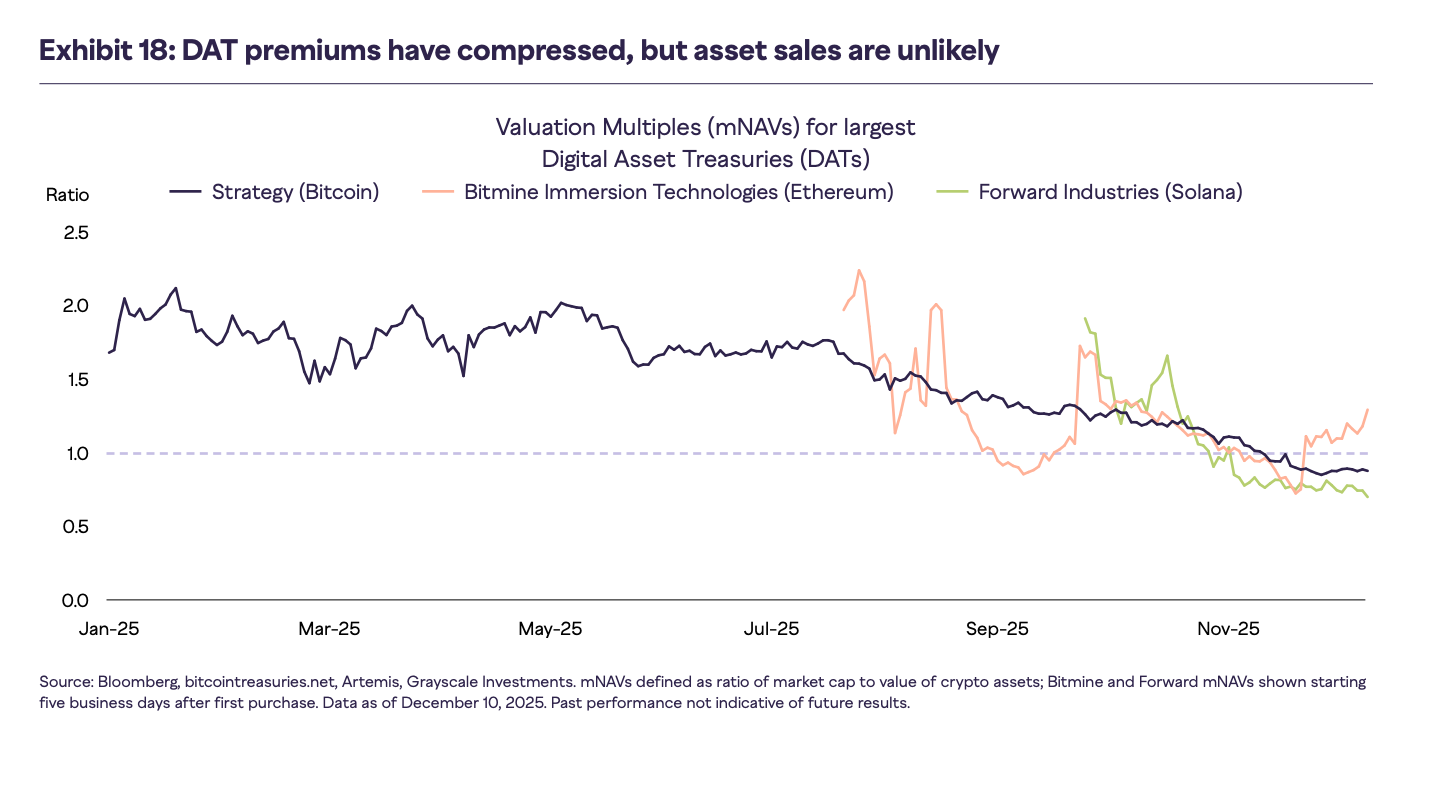
Grayscale's smart contract platform report identifies five networks with differentiated strategies and sustainable value-capture potential: ETH, SOL, SUI, BNB, and AVAX. Additionally, The LINK Between Worlds treats Chainlink separately as critical tokenization infrastructure. Here's how the institutional selection logic breaks down for the five assets most relevant to this analysis:
ETH — The Premium Chain with Proven Value Accrual. ETH and SOL together account for roughly 70% of investable crypto market cap excluding Bitcoin. Ethereum leads all competitors in TVL by more than 7x, reflecting its deep liquidity advantage for financial applications. Grayscale considers transaction fee revenue the single most important fundamental metric for smart contract platform valuation, and Ethereum has the most mature value-accrual structure by that measure. For institutions, it's the most explainable, most battle-tested smart contract asset available.
SOL — The High-Performance Leader in Usage Metrics. Solana currently leads the category in daily active users, transaction volume, and transaction fees — arguably the three most important measures of blockchain activity. Its design trade-off (speed and low cost over maximum decentralization) has attracted high-frequency use cases including DePIN and retail-facing applications. Grayscale itself notes that Solana was once dismissed as "excess block space" before a wave of adoption made it one of the industry's best success stories.
LINK — Tokenization's Critical Middleware. LINK isn't a smart contract platform — it's the infrastructure layer that connects all of them to the real world. Grayscale describes Chainlink as the "critical connective tissue" between crypto and traditional finance. With tokenized assets representing just 0.01% of global fixed income and equity securities, the growth runway is enormous. Chainlink's CCIP (Cross-Chain Interoperability Protocol) has already been validated through pilots with J.P. Morgan's Kinexys and UBS. Grayscale's head of research Zach Pandl recently stated that chain-agnostic service providers like Chainlink may be "even more compelling" than some blockchains themselves.
SUI — Next-Generation Consumer Scalability. SUI is engineered for mass-market applications, and Grayscale sees its architecture as uniquely suited for emerging categories such as AI micropayments, real-time gaming, and high-frequency on-chain trading. It doesn't yet have ETH or SOL's track record, but its technical design and team capabilities put it on institutional watchlists as a "next generation" candidate.
AVAX — The Institutional Customization Model. Avalanche's subnet-based architecture enables custom blockchain deployments, and Grayscale positions it as a leader in mass customization. Notably, Pandl laid out a tokenization roadmap in stages: permissioned systems like Canton first, then hybrid models like Avalanche, and ultimately decentralized platforms like Ethereum. AVAX sits at the middle stage of that arc — a potential beneficiary as tokenization matures beyond its earliest phase.
DATA BOX — Grayscale's Platform Selection Logic
Key figures: ETH + SOL ≈ 70% of investable crypto market cap ex-BTC | U.S. advised wealth crypto allocation: < 0.5% | Tokenized assets = 0.01% of global securities
Sources: Grayscale Smart Contract Platforms, 2026 Outlook, The LINK Between Worlds
The takeaway isn't "buy all five." It's that if alt repricing happens in this cycle, it will likely start with these kinds of assets — large, explainable, product-ready — rather than spreading evenly across thousands of tokens.
4. XRP Is a Different Story — Not Institutional Adoption, but Micro-Supply Dynamics
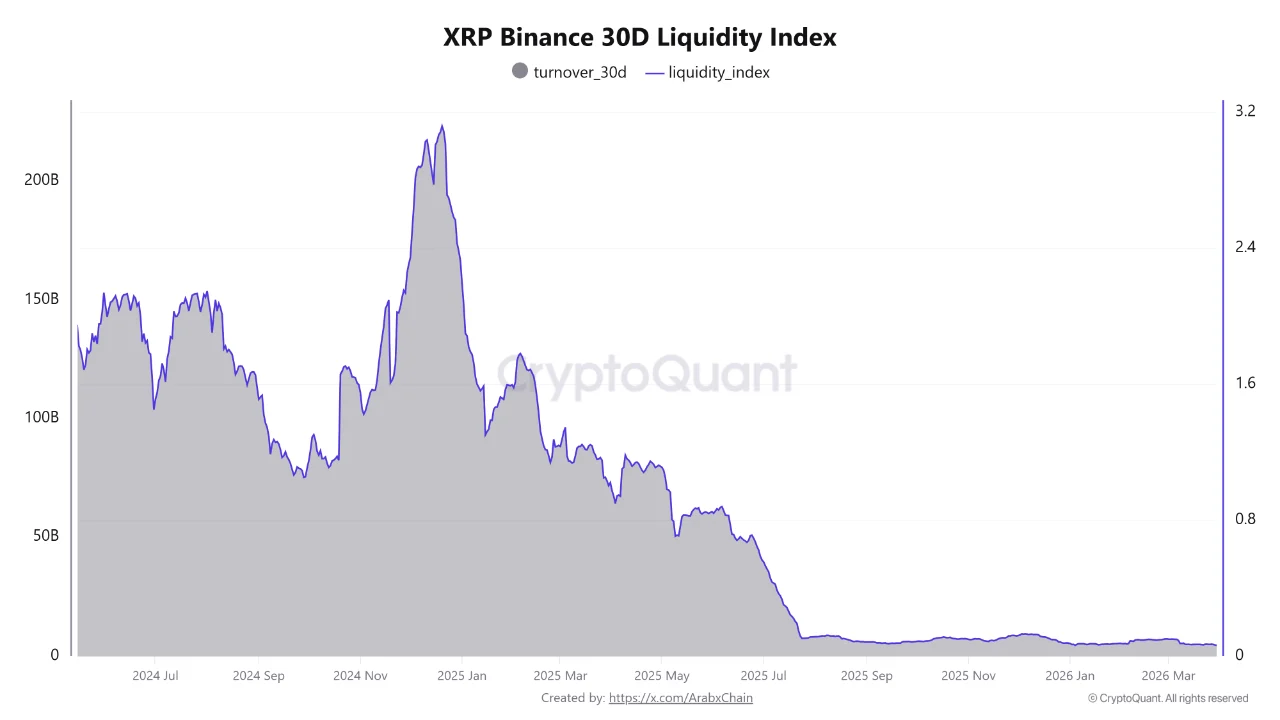
This is where XRP needs to be separated from the rest. Lumping XRP in with ETH and SOL blurs the analysis. ETH and SOL are being discussed in the context of institutional platform adoption. XRP, at least within this particular four-issue framework, isn't being re-rated in the same way. What makes XRP interesting here is bottom-up supply dynamics, not top-down institutional endorsement.
CryptoQuant's recent QuickTake shows that over the past 30 days, Binance recorded approximately 310,500 XRP deposit transactions against roughly 329,400 withdrawals — a net outflow of about 18,900 transactions. At the same time, overall transaction activity has fallen to its lowest level since 2025, down dramatically from periods when 30-day activity exceeded 6 million transactions.
Two readings of this data exist, and intellectual honesty requires holding both. The cold read: interest has dried up, speculative capital has left, and the declining activity simply reflects a market that has moved on. This is entirely plausible. The alternative read: if net outflows persist even when activity is this quiet, someone is steadily moving supply off exchanges and into cold storage — behavior consistent with holders who have no near-term intention to sell.
Neither reading should be treated as conclusive. Calling net outflows "accumulation" without further evidence is overreach. But dismissing the data as meaningless noise is equally premature. In a market that's restructuring rather than chasing momentum, the quietest supply-side movements sometimes carry the most forward-looking information. XRP's data doesn't predict a rally. What it does is flag that even in an overlooked asset, supply-side dynamics are worth watching separately from the institutional adoption narrative.
DATA BOX — XRP Binance Supply Data (30-day) Deposits: ~310,500 tx | Withdrawals: ~329,400 tx | Net outflow: ~-18,900 tx | Activity level: Lowest since 2025 (vs. 6M+ tx peak) | Reading: Interest decline + quiet supply migration coexist
Source: CryptoQuant QuickTake
5. The Real Takeaway — It's Not About Price, It's About Sequence
Compress these four issues into a single sentence and you get this: Wall Street's return to crypto may have already begun, but it is not arriving equally.
The door opens for BTC and ETH first. The allocation thesis revives around Bitcoin first. Alts come next, but only the ones that are large enough, explainable enough, and product-ready enough — ETH and SOL as platform assets, LINK as tokenization middleware, with SUI and AVAX on the watchlist. XRP lives on a different axis altogether — one defined by micro-supply flows rather than institutional endorsement.
The worst interpretation available right now is "institutions are coming, so everything moons." That's not what the data shows. A more accurate statement: institutional re-entry is already revealing the hierarchy within crypto itself. Bitcoin is being re-read through a hard-money lens. ETH and SOL are being selected as platform assets. LINK is being positioned as tokenization infrastructure. And XRP is being observed — quietly — for supply-side signals that the broader market hasn't priced in.
The framework that matters remains liquidity, regulation, and structure. Where is liquidity redirecting? Which assets are regulation opening doors for first? What products and platforms are pulling assets into the institutional perimeter? When these three align, price follows. When you only watch price, you only catch the last frame.
Conclusion — Watch for Inclusion, Not Explosion
The conclusion worth stating plainly is this: the current market is better read not as a competition between Bitcoin, ETH, and XRP for short-term gains, but as a sequencing exercise — which assets are being included in institutional portfolios, in what order, and through what channels.
Three observation points follow from this framework, and tracking them over the coming months will be more productive than any price prediction. First, Schwab's actual launch and the resulting BTC/ETH trading volume data. Second, the progress of ETP filings and staking expansion for the assets Grayscale has highlighted. Third, whether the net outflow trend in XRP and other under-watched assets persists, stabilizes, or reverses.
These are the questions that matter in a market where structure is being built before price catches up.
FAQ
Q: Does Schwab entering crypto automatically mean a bull market? Not directly. But a brokerage of Schwab's scale opening direct BTC and ETH trading is a structural signal that crypto is being integrated deeper into mainstream financial infrastructure — which is a precondition for larger capital flows.
Q: Is Fidelity saying gold is dead and Bitcoin wins? No. The more precise reading is that gold has overextended relative to Bitcoin, and some capital is beginning to reconsider Bitcoin as a hard-money alternative. This is a portfolio rebalancing thesis, not a gold obituary.
Q: Did Grayscale call for an alt season? Not in those terms. Grayscale's framework is closer to selective repricing of large, institutionally explainable assets — evaluated on fundamentals like fee revenue, TVL, and transaction volume — rather than a broad-based alt rally.
Q: Is XRP's net outflow a confirmed accumulation signal? It can't be stated definitively. However, the coexistence of declining trading activity and persistent net outflows creates a zone where both "fading interest" and "quiet supply migration" may be occurring simultaneously — making it worth monitoring from a supply-demand perspective.
Source Table
Primary Sources
| # | Source | URL |
|---|---|---|
| 1 | Charles Schwab — Cryptocurrency | https://www.schwab.com/cryptocurrency |
| 2 | Fidelity — Q1 2026 Review & Q2 Outlook | https://www.fidelity.com/learning-center/trading-investing/crypto/ccl-q1-2026-recap-q2-outlook-crypto-vid |
| 3 | Grayscale — 2026 Digital Asset Outlook: Dawn of the Institutional Era | https://research.grayscale.com/reports/2026-digital-asset-outlook-dawn-of-the-institutional-era |
| 4 | Grayscale — Investing in Smart Contract Platforms | https://research.grayscale.com/reports/investing-in-smart-contract-platforms |
| 5 | Grayscale — The LINK Between Worlds | https://research.grayscale.com/reports/the-link-between-worlds |
| 6 | CryptoQuant — XRP Liquidity Index QuickTake | https://cryptoquant.com/insights/quicktake/69cdd963cc62714169db1241-XRP-Liquidity-Index-Falls-to-One-of-Its-Lowest-Levels-as-Trading-Activity-Weaken |
Secondary Sources
| # | Source | URL |
|---|---|---|
| 7 | Decrypt — Charles Schwab Bitcoin Ethereum Spot Trading | https://decrypt.co/363336/charles-schwab-bitcoin-ethereum-spot-trading |
| 8 | Fidelity: Bitcoin Winning Back Gold Investors | https://bitcoinethereumnews.com/bitcoin/fidelity-bitcoin-winning-back-gold-investors/ |
| 9 | CoinDesk — Grayscale Research Head on Tokenization Waves | https://www.coindesk.com/markets/2026/04/01/grayscale-s-research-head-says-tokenization-will-happen-in-waves-and-explains-how-to-play-it |
Contextual References
| # | Source | URL |
|---|---|---|
| 10 | Grayscale — The Battle for Value in Smart Contract Platforms | https://research.grayscale.com/reports/the-battle-for-value-in-smart-contract-platforms |
| 11 | Grayscale — Q4 2025 Crypto Sectors Research Insights | https://research.grayscale.com/market-commentary/grayscale-research-insights-crypto-sectors-in-q4-2025 |
| 12 | CoinDesk — Grayscale Adds Staking to ETH and SOL Products | https://www.coindesk.com/business/2025/10/06/grayscale-adds-staking-to-ethereum-and-solana-investment-products-in-u-s-first |
Disclaimer
This article is for informational purposes only and does not constitute investment advice or a recommendation to buy or sell any asset. Cryptocurrency investments carry a high degree of risk, including the potential loss of principal. All investment decisions should be made based on your own research and judgment. The research, data, and analyses cited in this article reflect the views of their respective institutions and may not have been independently verified by the author. Independent research and professional consultation are strongly recommended before making any investment decisions.
![[마켓 분석] 비트코인 8만 달러 앞에서 멈춘 시장](https://storage.ghost.io/c/8c/af/8caf2296-06bf-4501-ae99-5e72cb676b76/content/images/size/w600/2026/04/63d9df35-5d28-48fe-9a7a-3f651c82aafe.png)