Institutions Bought 94,000 BTC in a Single Month — So Why Isn't the Price Moving?
Institutions bought 94,000 BTC in a single month. So why isn't the price moving? Bitcoin isn't weak — its ownership is changing hands. A structural analysis of war-driven discount rates and whale distribution.

Bitcoin isn't weak. Its ownership is changing hands. War is lifting the discount rate, whales are offloading, and institutions are absorbing — what matters now isn't price, but who holds the supply.
The fatigue among Bitcoin investors is understandable. Institutions are reportedly pouring in at record pace, yet the price stays heavy. War risk keeps escalating, yet the market refuses to fully break down. Every week brings another round of "it's over" and "it's just beginning" — but what actually moves the price is never the headline itself. It's the structure underneath the headline. This post unpacks that structure in more detail than the broadcast allowed. The core thesis is simple: Bitcoin right now is less a weak asset and more an asset whose ownership base is being reshuffled.

DATA BOX: 5 Key Facts Behind This Analysis
① As of April 4, 2026, President Trump issued a 48-hour ultimatum to Iran demanding the reopening of the Strait of Hormuz, while a U.S. F-15E was shot down and an A-10 went down over the Persian Gulf in separate incidents. ② CoinDesk, citing CryptoQuant data, reported that institutional channels including ETFs and Strategy absorbed approximately 94,000 BTC during March alone. ③ Despite this, overall net demand came in at −63,000 BTC for the month, with non-institutional participants estimated to have sold roughly 157,000 BTC. ④ Whales holding 1,000–10,000 BTC distributed approximately 188,000 BTC over the past year, flipping from the market's largest buyers to its largest sellers. ⑤ On April 4, Michael Saylor posted on X that "the four-year cycle is dead" and that "price is now driven by capital flows."
1. What's Weighing on Bitcoin Isn't "Bad News" — It's a Collision of Pricing Power
Reading the AP report alongside Bloomberg's coverage, the essence of this Middle East variable goes beyond a simple war headline. President Trump imposed a hard "48 hours" deadline on Iran, but on the battlefield, a U.S. F-15E Strike Eagle was shot down, an A-10 Warthog went down over the Persian Gulf, and a search-and-rescue operation for a missing crew member was underway. The political message said "control." The battlefield said "cracks in that control."
Markets are always sensitive to this kind of mismatch. When reality runs ahead of rhetoric, investors demand a higher discount rate on price. The Strait of Hormuz is particularly consequential — roughly one-fifth of the world's seaborne oil and LNG passes through it. According to CBS News live updates, shipping traffic through the strait has virtually halted since the war began. Chicago Fed President Austan Goolsbee noted that the war risks fueling inflation, adding that his earlier optimism about rate cuts this year had weakened. Domestically, U.S. polls show majority disapproval of both the war and the presidential response, while Republican lawmakers are increasingly concerned about the November midterms.
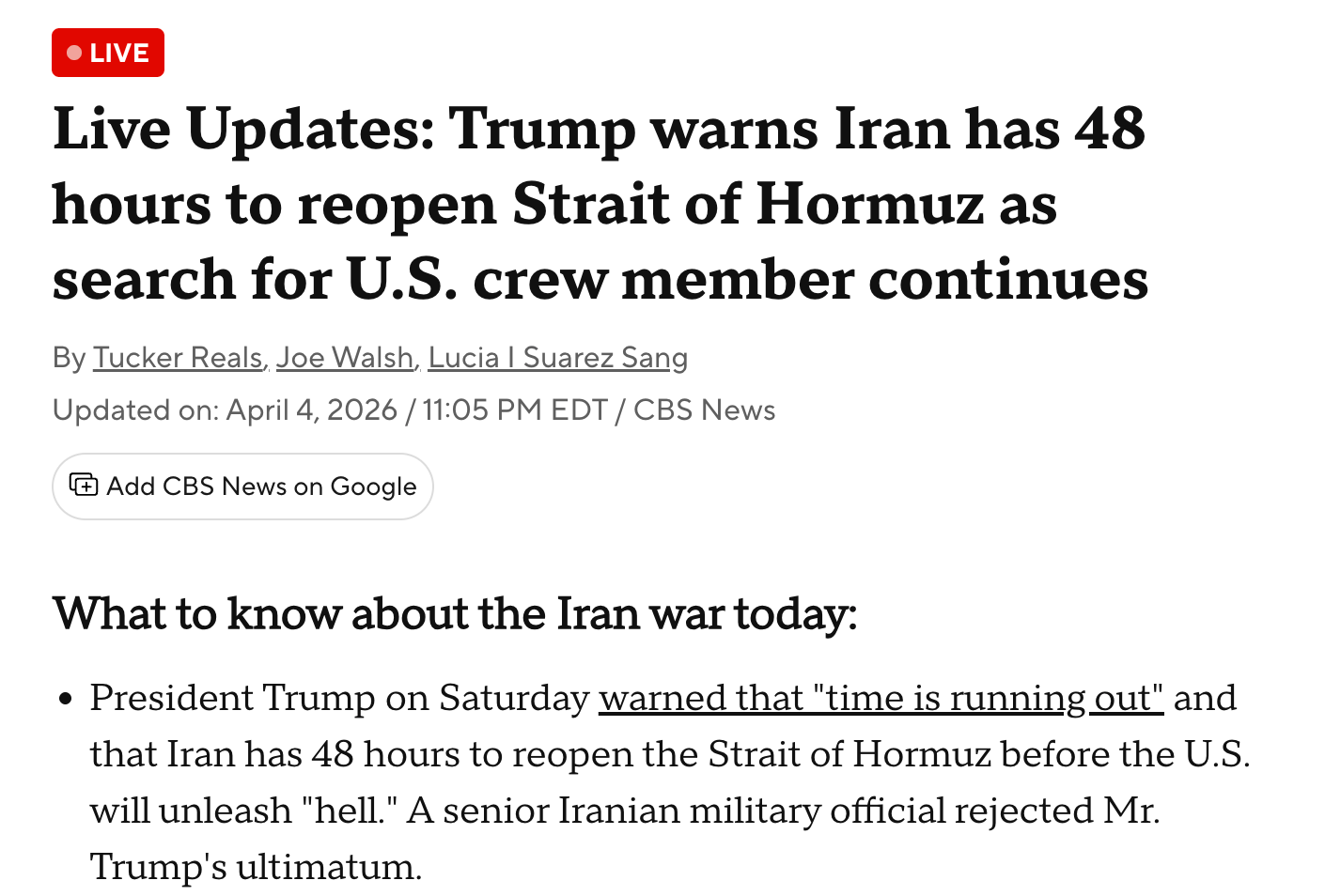
The point here is not the simplistic claim that "war exists, therefore Bitcoin can't rally." A more precise framing is this: war risk is elevating the discount rate across the entire market, and on top of that elevated rate, Bitcoin's internal supply-demand dynamics are determining price elasticity. Externally, macro anxiety raises the hurdle rate. Internally, who is buying more and who is selling more determines how much the price can actually move. Because both axes are operating simultaneously, Bitcoin looks inexplicably weak on some days and surprisingly resilient on others.
DATA BOX: How Hormuz Risk Transmits to Bitcoin
Hormuz blockade → crude oil spike → logistics disruption → rising inflation expectations → Fed rate path uncertainty → higher risk-asset discount rate → downward pressure on all risk-asset valuations, Bitcoin included. Throughout the Iran conflict, Bitcoin has traded in a $65,000–$73,000 range, selling on escalation headlines and bouncing on de-escalation headlines.
2. Institutions Are Buying — So Why Is the Price Heavy? This Market Isn't Short on Demand. It's in an Ownership Transition.
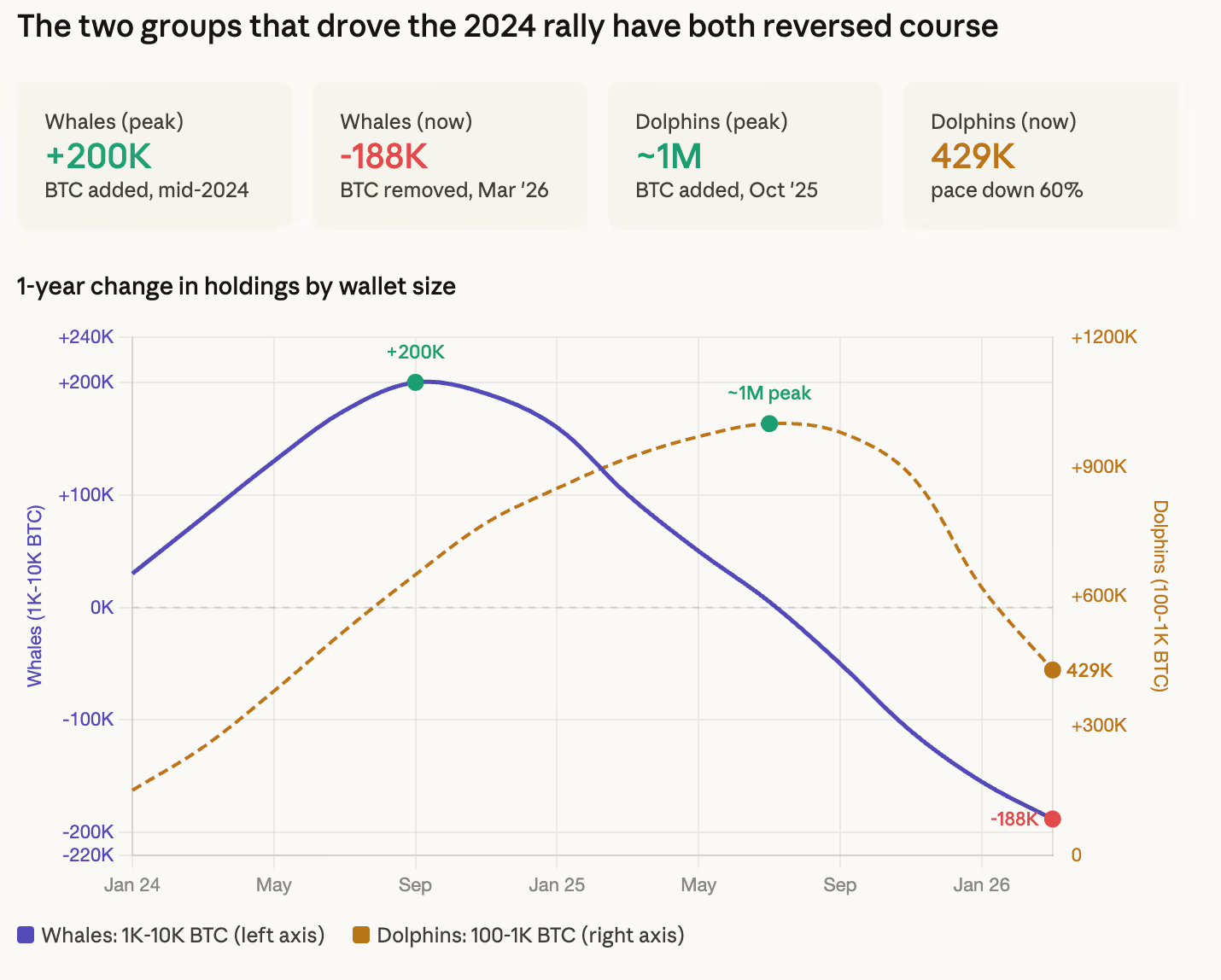
This is the most critical piece of the current puzzle. CoinDesk's April 3 analysis, citing CryptoQuant's weekly report, shows that institutional channels — ETFs and Strategy (formerly MicroStrategy) — absorbed approximately 94,000 BTC during March. ETFs accounted for roughly 50,000 and Strategy for roughly 44,000. This was the fastest pace of institutional accumulation since October 2025.
On the surface, that looks like formidable demand. The problem is that it didn't translate into price appreciation. Net apparent demand for the same period came in at −63,000 BTC. By CoinDesk's math, non-institutional participants — whales, miners, and legacy holders — sold approximately 157,000 BTC during the same window. In particular, the whale cohort holding 1,000–10,000 BTC, which just a year ago was collectively adding around 200,000 BTC annually as the market's single largest buyer, has flipped. That same cohort is now distributing approximately 188,000 BTC per year, making it the market's single largest seller. Over roughly 18 months, a position swing of approximately 400,000 BTC has occurred.
Understanding this changes what the current range-bound market actually means. Many investors interpret sideways action as a market with "no energy." But this particular range is closer to a stress test of who can absorb supply longer. Institutions are entering through ETFs and corporate treasury strategies with relatively long-duration capital. Legacy whales and miner-affiliated entities are supplying liquidity at elevated price levels. This isn't a simple standoff. It can be read as a migration of pricing power — away from retail and early large holders, toward institutional channels and long-term capital.
To be clear, that migration is not yet complete. But dismissing institutional buying as "meaningless because the price isn't rising" is an excessively surface-level interpretation. Price is heavy not because demand is absent, but because both the demand side and the supply side have scaled up simultaneously.
DATA BOX: Supply-Demand Structure Summary — March 2026
| Item | Figure |
|---|---|
| Institutional accumulation (ETFs + Strategy) | +94,000 BTC |
| ETF purchases | ~50,000 BTC |
| Strategy purchases | ~44,000 BTC |
| Overall net demand (monthly) | −63,000 BTC |
| Estimated non-institutional selling | ~157,000 BTC |
| Whale distribution (1K–10K BTC, annualized) | −188,000 BTC |
Source: CoinDesk / CryptoQuant Weekly Report
3. Saylor's "Death of the Four-Year Cycle" Is Not a Price Prediction — It's a Declaration of a New Market Grammar
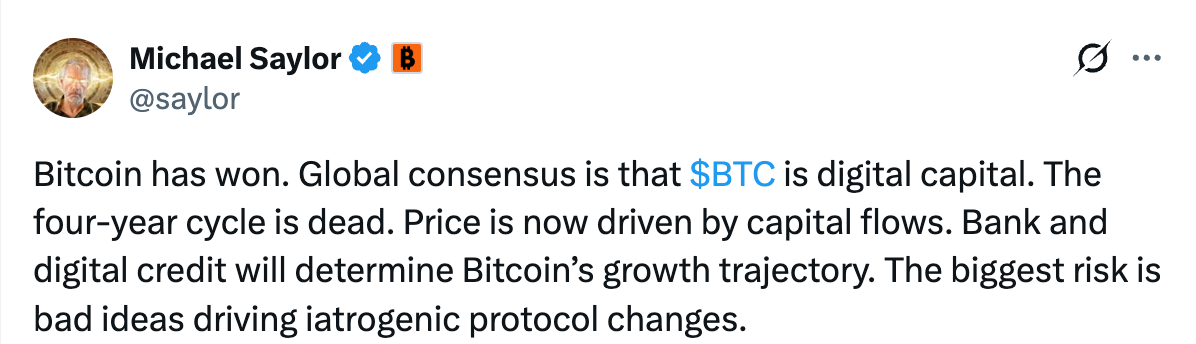
Michael Saylor's April 4 post on X carries meaning beyond a simple bullish call. As reported by CryptoTimes and Stocktwits, Saylor stated that "Bitcoin has won," that global consensus now views BTC as "digital capital," that "the four-year cycle is dead," and that "price is now driven by capital flows."
Reading this at face value as "a rally is imminent" invites disappointment. A more productive reading is this: Saylor is attempting to shift the framework through which Bitcoin's price formation is understood — from the halving-mining-cycle narrative to an ETF-balance sheet-digital credit-capital markets narrative. The old grammar said that halvings reduce supply, prices rise, bubbles burst, and the cycle repeats every four years. Saylor's claim is that this grammar no longer holds.
The reason this view gains traction is that it dovetails with the supply-demand data above. If institutional channels are actually absorbing 94,000 BTC and the price still isn't moving decisively, this may look bearish in the short term but could signal a structural reshuffling of the holder base over the longer term.
That said, Saylor is not a disinterested observer. According to Techi's comprehensive Strategy analysis, Strategy holds 762,099 BTC at an average cost of approximately $75,694, putting the position roughly $6 billion underwater at current prices. His statement therefore carries both a structural thesis and an unavoidable element of position talk. Both dimensions should be weighed simultaneously.
4. The Counterpoint: "More Time Is Needed" Remains Very Much Alive
The bearish case is far from trivial. Cointelegraph reported that veteran trader Peter Brandt pushed back his timeline for a new all-time high to no earlier than Q2 2027. He does not see a new high in 2026 and flagged the possibility of a retest near $60,000 around September or October. On prediction market Polymarket, the probability of Bitcoin reclaiming $120,000 this year is assessed at roughly 15%.
Analyst Willy Woo estimated that, from a liquidity standpoint, Bitcoin is approximately one-third of the way through its bear market. Anthony Scaramucci, managing partner at SkyBridge, echoed that Bitcoin remains in the bear phase of the four-year cycle, adding that self-fulfilling prophecy dynamics among veteran holders continue to reinforce that pattern.
This contrast is actually what makes the current market legible. We are not in a market where one narrative has won. We are in a market where the structural-transition thesis and the extended-correction thesis are both alive and competing. One side says the halving-driven four-year cycle is dead. The other says more time is needed, and a deeper floor test may still lie ahead. This is precisely why what matters now is not prediction, but conditions.
DATA BOX: Bull Case vs. Correction Case — Side by Side
| View | Core Thesis | Key Voice |
|---|---|---|
| Structural transition | Four-year cycle is dead; capital flows now drive price | Michael Saylor |
| Extended correction | New ATH not until Q2 2027; $60K retest possible in Q3–Q4 | Peter Brandt |
| Mid-bear assessment | Liquidity suggests bear market is only one-third complete | Willy Woo |
| Cautious optimism | New ATH still possible within 2026 | Tom Lee |
5. What to Watch — A Bitcoin Conditions Checklist
Rather than betting on a direction, the more practical approach at this juncture is to track which conditions are switching on.
Condition ① — Does institutional net buying overtake whale net selling? As the CoinDesk analysis showed, even record institutional accumulation cannot lift price if legacy-holder distribution is larger. The moment on-chain data confirms a reversal of this dynamic is the first actionable signal.
Condition ② — Does the war discount rate decline? Hormuz anxiety, downed fighter jets, surging crude, and Fed rate-path uncertainty all need to cool before risk-asset discount rates can compress. Bitcoin's pattern of selling on escalation and bouncing on de-escalation only breaks when the geopolitical variable itself shifts.
Condition ③ — Does a breakout above $71,000 convert into confirmed support? This level is less about a round number and more about the inflection point where market psychology flips from selling rallies to buying dips.
If two or more of these three conditions activate, a credible case for an upside breakout from the current range begins to form. Conversely, attempting to call direction while all three remain off is structurally unsupported.
FACT / INTERPRETATION / IMPLICATION
FACT: The Middle East conflict remained in an escalatory phase as of April 4, 2026, with Trump's 48-hour ultimatum, downed U.S. fighter jets, a missing crew member, and Hormuz disruption all reported simultaneously. In the same window, Bitcoin's market showed institutional absorption of approximately 94,000 BTC, overall net demand of −63,000 BTC, and annualized whale distribution of approximately 188,000 BTC.
INTERPRETATION: Bitcoin is not in a simple sideways market. It may be in a phase where pricing power is migrating. Institutional buying alone does not justify optimism, nor do war risk and whale selling alone justify pessimism. Bitcoin may be an asset whose rally is delayed — but it may also be an asset whose ownership structure is being rewritten.
IMPLICATION: Going forward, the conditions to monitor are: (1) whether institutional net buying overtakes whale net selling, (2) whether the war-driven discount rate declines, and (3) whether a breakout above $71,000 holds as support. Headlines will be abundant. What actually helps investment decisions is whether these conditions are switching on.
Conclusion: Reading Structure Means Having Better Questions, Not Better News
Bitcoin right now is neither "institutions are buying so it's good" nor "war plus whale selling so it's over." Price is always a function of who holds the supply and what risks are priced in. The question that matters more than why institutions are buying is whether that buying is outpacing the selling on the other side. Hold that question, and even in a market as noisy as this one, it becomes possible to follow structure rather than chase price. Read the conditions. Reserve conviction.
A separate post covering the legal discount rate analysis for Ripple/XRP will follow.
Source Table
Primary Sources
| No. | Source | URL |
|---|---|---|
| 1 | CoinDesk — "Five data sources say the same thing: it's thinning from the inside" | https://www.coindesk.com/markets/2026/04/03/five-data-sources-say-the-same-thing-about-bitcoin-market-it-s-thinning-from-the-inside |
| 2 | AP via TNND — Trump 48-hour ultimatum to Iran | https://thenationaldesk.com/news/americas-news-now/all-hell-will-reign-down-trump-gives-iran-48-hour-ultimatum-over-strait-of-hormuz-oil-gas-gasoline-military-escalation-war-conflict-operation-epic-fury-attacks-strikes-united-states-israel-president-donald-trump-peace-talks |
| 3 | Bloomberg — F-15 downed in Iran, US searches for crew | https://www.bloomberg.com/news/articles/2026-04-03/us-mounts-rescue-operation-for-f-15-fighter-jet-downed-in-iran |
| 4 | CBS News — Iran war live updates | https://www.cbsnews.com/live-updates/iran-war-us-trump-warns-more-coming-oil-gas-strait-hormuz/ |
Secondary Sources
| No. | Source | URL |
|---|---|---|
| 5 | CryptoTimes — Saylor says Bitcoin cycle dead | https://www.cryptotimes.io/2026/04/05/michael-saylor-says-bitcoin-cycle-dead-points-to-capital-flows/ |
| 6 | Cointelegraph — Peter Brandt, Polymarket traders don't see new highs | https://cointelegraph.com/news/peter-brandt-polymarket-traders-new-bitcoin-highs-unlikely-2026 |
| 7 | Axios — US fighter jet shot down over Iran | https://www.axios.com/2026/04/03/iran-us-fighter-shot-down |
| 8 | CBS News — F-15E shot down, crew member rescued | https://www.cbsnews.com/news/american-fighter-jet-f15e-downed-over-iran/ |
Contextual Sources
| No. | Source | URL |
|---|---|---|
| 9 | Stocktwits — Strategy's Saylor says Bitcoin has won | https://stocktwits.com/news-articles/markets/cryptocurrency/strategy-s-michael-saylor-says-bitcoin-has-won-declares-end-of-four-year-cycle/cZJT9A5RIod |
| 10 | Techi — MicroStrategy and Michael Saylor Bitcoin Strategy explained | https://www.techi.com/microstrategy-michael-saylor-bitcoin-strategy/ |
| 11 | Bloomberg — Trump warns Iran has 48 hours left | https://www.bloomberg.com/news/articles/2026-04-04/us-searches-for-downed-airman-as-iran-keeps-striking-gulf-states |
This post does not constitute a recommendation to buy or sell any asset. All investment decisions and their consequences are the sole responsibility of the investor. Cryptocurrencies carry high volatility and the risk of principal loss. The analysis and opinions contained herein are based on publicly available information at the time of writing and may change as circumstances evolve. Always consult a qualified professional before making investment decisions.
![[마켓 분석] 비트코인 8만 달러 앞에서 멈춘 시장](https://storage.ghost.io/c/8c/af/8caf2296-06bf-4501-ae99-5e72cb676b76/content/images/size/w600/2026/04/63d9df35-5d28-48fe-9a7a-3f651c82aafe.png)